
Treasury CFIUS Pilot Program Overlaps with Made in China 2025 Sectors
Client Alert | 2 min read | 11.08.18
On October 10, Treasury announced interim regulations to implement certain provisions of the Foreign Investment Review Modernization Act (FIRRMA), which President Trump signed into law on August 13, 2018. As part of that announcement, Treasury will initiate a pilot program imposing mandatory declarations on transactions involving certain sensitive sectors. That pilot program is due to go into effect on November 10, 2018. For additional details on Treasury’s interim rules and the mandatory declaration pilot program, please see our client alert from October 17.
Although updates to the CFIUS review process do not specifically target Chinese investment, the amount of government influence in China’s outbound investment has figured heavily in the drafting of FIRRMA as well as in discussions of how Treasury will choose to implement FIRRMA.
China plays a large role in how the current Administration approaches trade and investment decision making, particularly when dealing with high-tech and advanced manufacturing sectors. China’s industrial policy,Made in China 2025, is one of the primary issues cited by USTR’s Section 301 investigation and report, which then led to the current U.S. tariff regime with levies in place on roughly $250 billion worth of Chinese imports.
After Treasury released its pilot program for mandatory declarations, including the list of 27 covered “pilot program industries,” one of the questions for analysis that has emerged is to what extent those sectors intersect with Made in China 2025 priority industries. Figure 1 and Figure 2 below provide an indication of just how closely aligned they are.
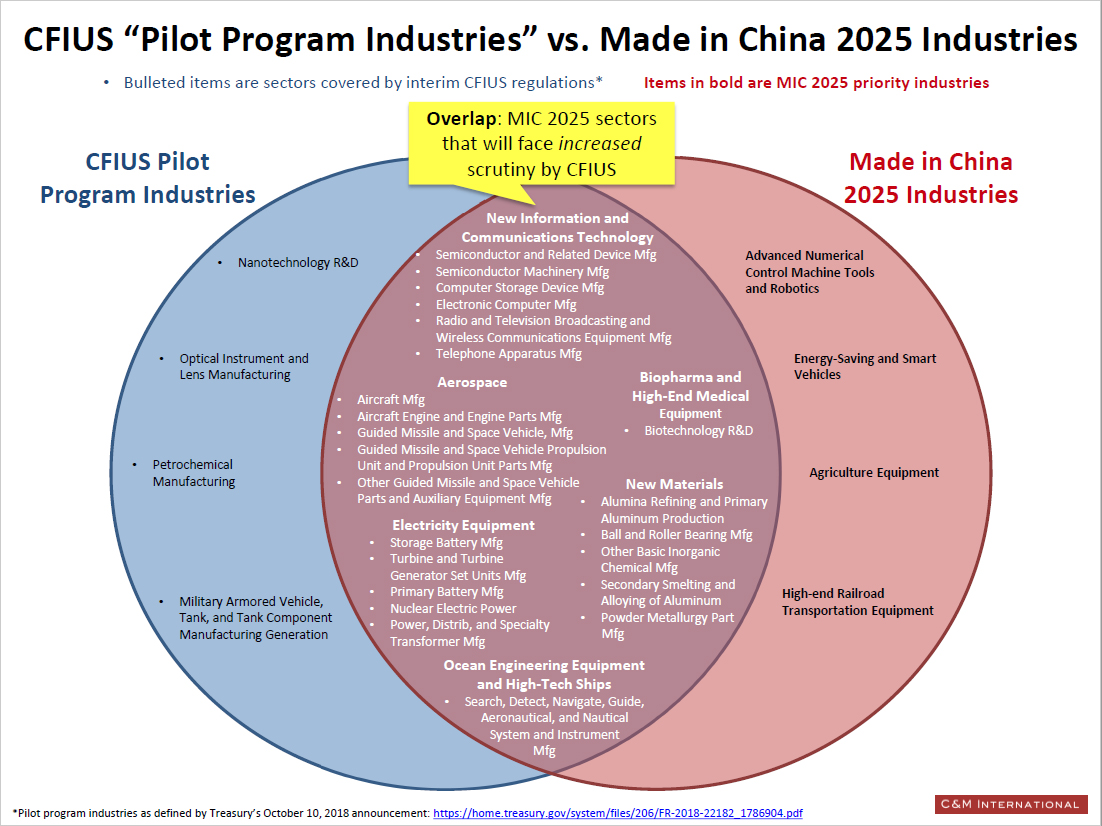
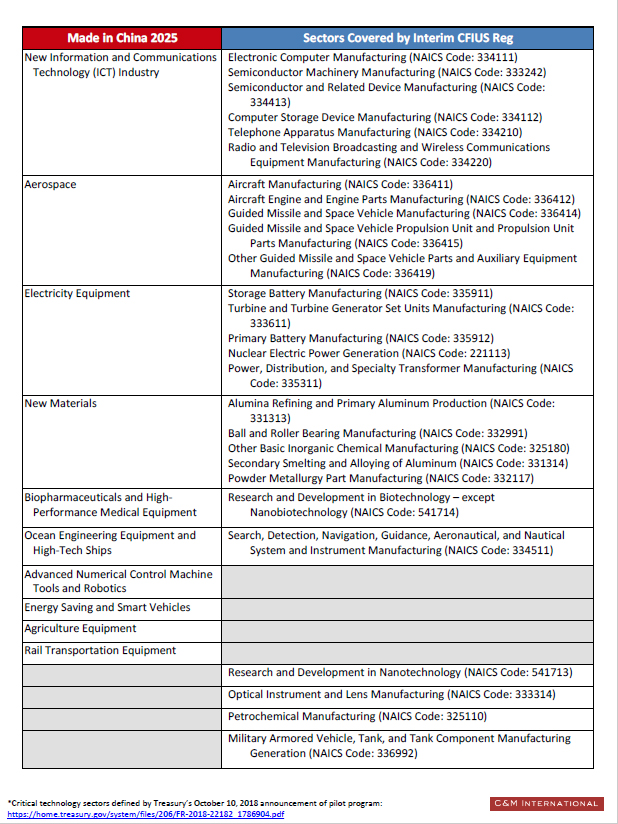
*Note: In developing the figures above, the CFIUS pilot program industries were matched with corresponding Made in China 2025 (MIC 2025) industries conceptually, based on where there is likely to be overlap. Because the MIC 2025 categories are broader, in reality China’s industrial policy may or may not include the specific products covered by the NAICS code listed in the CFIUS regulation. There could also be alignments between some CFIUS-referenced sectors and MIC 2025 industries that are not noted here.
C&M International LLC and Crowell & Moring LLP are tracking these rulemaking developments out of Treasury as they relate to new investment regulations and trade disputes through our regulatory work with government officials in both countries.
Contacts

Insights

Client Alert | 7 min read | 10.21.26
Securities Law for Entrepreneurs
Do you want your startup to expand and become a major player in your industry? If so, you will most likely need to seek capital from outside investors to help you build infrastructure and fulfill orders.
Client Alert | 3 min read | 10.15.26
Client Alert | 4 min read | 10.14.26
Misleading Privacy Claims Can Trigger Massive Consumer-Protection Liability
Client Alert | 5 min read | 10.13.26
