
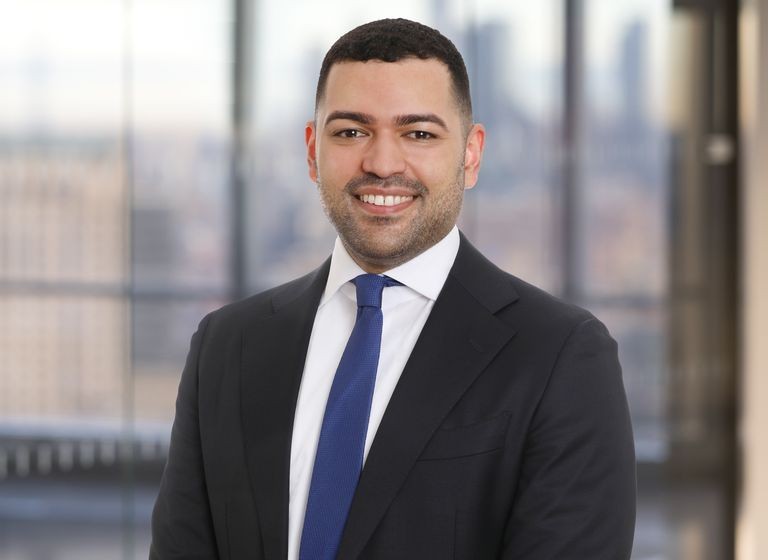
Alex Cruz Rodriguez
Areas of Focus
Overview
Alex Cruz Rodriguez concentrates on drafting, negotiating, and advising therapeutic product and medical device clients on agreements supporting all stages of product research and development, including clinical trials.
Alex’s clinical trial experience includes coordinating, drafting, and negotiating CRO, consulting and study start-up agreements, global clinical trial agreements, data privacy agreements, and informed consents for clinical studies ranging from a client’s first Phase 1 study to large, complex, multinational, pivotal clinical trials.
Career & Education
- U.S. Securities and Exchange Commission
Student Honors Program Extern, Enforcement Division - U.S. District Court for the Southern District of New York
Judicial Internship - U.S. District Court, District of Massachusetts
Judicial Internship
- U.S. Securities and Exchange Commission
- Law Clerk, Aterian, Inc. (formerly Mohawk Group Holdings, Inc.)
- Boston University School of Law, J.D.
- Emory University, B.A.
- New York
- New Jersey
- Member, OUTbio of Greater New York
- English
- Spanish (native)
- Italian
- French
- Korean (intermediate)
- Arabic (intermediate)
Alex's Insights

Client Alert | 9 min read | 10.21.26
The life sciences sector is uniquely vulnerable to the inherent risks of AI-generated evidence in drug development and discovery. This client alert focuses on five core challenges: hallucinations, skewed predictions from unrepresentative training data, the opacity of AI reasoning, input sensitivity that undermines reproducibility, and adversarial manipulation of training data. To address these risks, companies should use experimental validation and human oversight as the common legal and regulatory safety net. This entails among other measures auditing AI outputs, characterizing training data, and structural oversight. Companies also should prepare for evolving frameworks and guidance from the U.S. Food and Drug Administration (FDA) and the European Union (EU) that address use of AI in drug discovery and development .
Client Alert | 7 min read | 10.01.26
SEC and FDA Formalize Information-Sharing Framework for Public Companies
Client Alert | 6 min read | 09.28.26
Client Alert | 7 min read | 09.14.26
AI in Life Sciences: Ten Legal Considerations and Risks of AI Use in Drug Discovery and Development
Representative Matters
- Drafted and negotiated clinical study-related agreements for a venture-backed biotechnology company focused on kinase-inhibiting drugs for the treatment of cancers and immunological diseases, in support of a Phase III global study involving approximately 120 subjects across 35 sites worldwide, including the U.S., Germany, Greece, Italy, France, Spain, Poland, and the Netherlands.
- Drafted, negotiated, and coordinated clinical trial and related agreements for a publicly traded, clinical-stage biologics biopharmaceutical company in connection with its Phase II global clinical trials targeting autoimmune diseases, including lupus and multiple-sclerosis, and involving more than 190 subjects across more than 90 sites worldwide, including Belgium, Canada, Finland, and Romania.
- Drafted, negotiated, and coordinated clinical trial-related agreements for venture-backed biotechnology company for its early-phase clinical trial involving the company’s sonodynamic drug-device combination product in large U.S. research institutions.
- Drafted and negotiated agreements with service providers for clinical and preclinical studies of therapeutic and medical device products, including master services agreements valued at over $10 million with large, multinational contract research organizations.
Alex's Insights
Client Alert | 9 min read | 10.21.26
The life sciences sector is uniquely vulnerable to the inherent risks of AI-generated evidence in drug development and discovery. This client alert focuses on five core challenges: hallucinations, skewed predictions from unrepresentative training data, the opacity of AI reasoning, input sensitivity that undermines reproducibility, and adversarial manipulation of training data. To address these risks, companies should use experimental validation and human oversight as the common legal and regulatory safety net. This entails among other measures auditing AI outputs, characterizing training data, and structural oversight. Companies also should prepare for evolving frameworks and guidance from the U.S. Food and Drug Administration (FDA) and the European Union (EU) that address use of AI in drug discovery and development .
Client Alert | 7 min read | 10.01.26
SEC and FDA Formalize Information-Sharing Framework for Public Companies
Client Alert | 6 min read | 09.28.26
Client Alert | 7 min read | 09.14.26
AI in Life Sciences: Ten Legal Considerations and Risks of AI Use in Drug Discovery and Development
Insights



Industries
Alex's Insights
Client Alert | 9 min read | 10.21.26
The life sciences sector is uniquely vulnerable to the inherent risks of AI-generated evidence in drug development and discovery. This client alert focuses on five core challenges: hallucinations, skewed predictions from unrepresentative training data, the opacity of AI reasoning, input sensitivity that undermines reproducibility, and adversarial manipulation of training data. To address these risks, companies should use experimental validation and human oversight as the common legal and regulatory safety net. This entails among other measures auditing AI outputs, characterizing training data, and structural oversight. Companies also should prepare for evolving frameworks and guidance from the U.S. Food and Drug Administration (FDA) and the European Union (EU) that address use of AI in drug discovery and development .
Client Alert | 7 min read | 10.01.26
SEC and FDA Formalize Information-Sharing Framework for Public Companies
Client Alert | 6 min read | 09.28.26
Client Alert | 7 min read | 09.14.26
AI in Life Sciences: Ten Legal Considerations and Risks of AI Use in Drug Discovery and Development
