
Section 5949 Proposed Rule Puts the FAR Council's Chips on the Table
What You Need to Know
Key takeaway #1
The Federal Acquisition Regulatory Council (FAR Council) released a Proposed Rule to implement Section 5949 of the FY 2023 NDAA regarding the prohibition on semiconductor products and services produced or furnished by certain Chinese manufacturers, currently Semiconductor Manufacturing International Corporation (SMIC), ChangXin Memory Technologies (CXMT) or Yangtze Memory Technologies Corp (YMTC), and any of their affiliates (subject to additional entities being added at a later time). The prohibitions under Section 5949 take effect on December 23, 2027.
Key takeaway #2
Companies should consider submitting comments, questions, and responses to the Proposed Rule by the April 20, 2026 deadline.
Key takeaway #3
This Proposed Rule furthers the intensive supply chain scrutiny faced by government contractors, following earlier similar rulemaking such as Section 889 and the more recent Federal Acquisition Supply Chain Security Act (FASCSA) orders implementation. Companies should consider conducting additional supply chain mapping to anticipate impact on the required certifications ahead of the proposed rule going into effect and should evaluate alternative sourcing methods as relevant.
Client Alert | 7 min read | 02.20.26
On February 17, 2026, the Federal Acquisition Regulatory Council (FAR Council) released a Proposed Rule (Proposed Rule) to implement Section 5949(a) of the James M. Inhofe National Defense Authorization Act (NDAA) for Fiscal Year (FY) 2023 (Section 5949), following the FAR Council’s May 3, 2024 Advanced Notice of Proposed Rulemaking (ANPR). Comments on the proposed rule are due by April 20, 2026.
Section 5949 contains two agency prohibitions on the purchase or use of “covered semiconductor products or services,” defined as those designed, produced, or provided by Semiconductor Manufacturing International Corporation (SMIC), ChangXin Memory Technologies (CXMT) or Yangtze Memory Technologies Corp (YMTC), and any of their affiliates. Both prohibitions will apply to all procurements, including commercially available off-the-shelf (COTS) items, and purchases below the micro-purchase threshold.
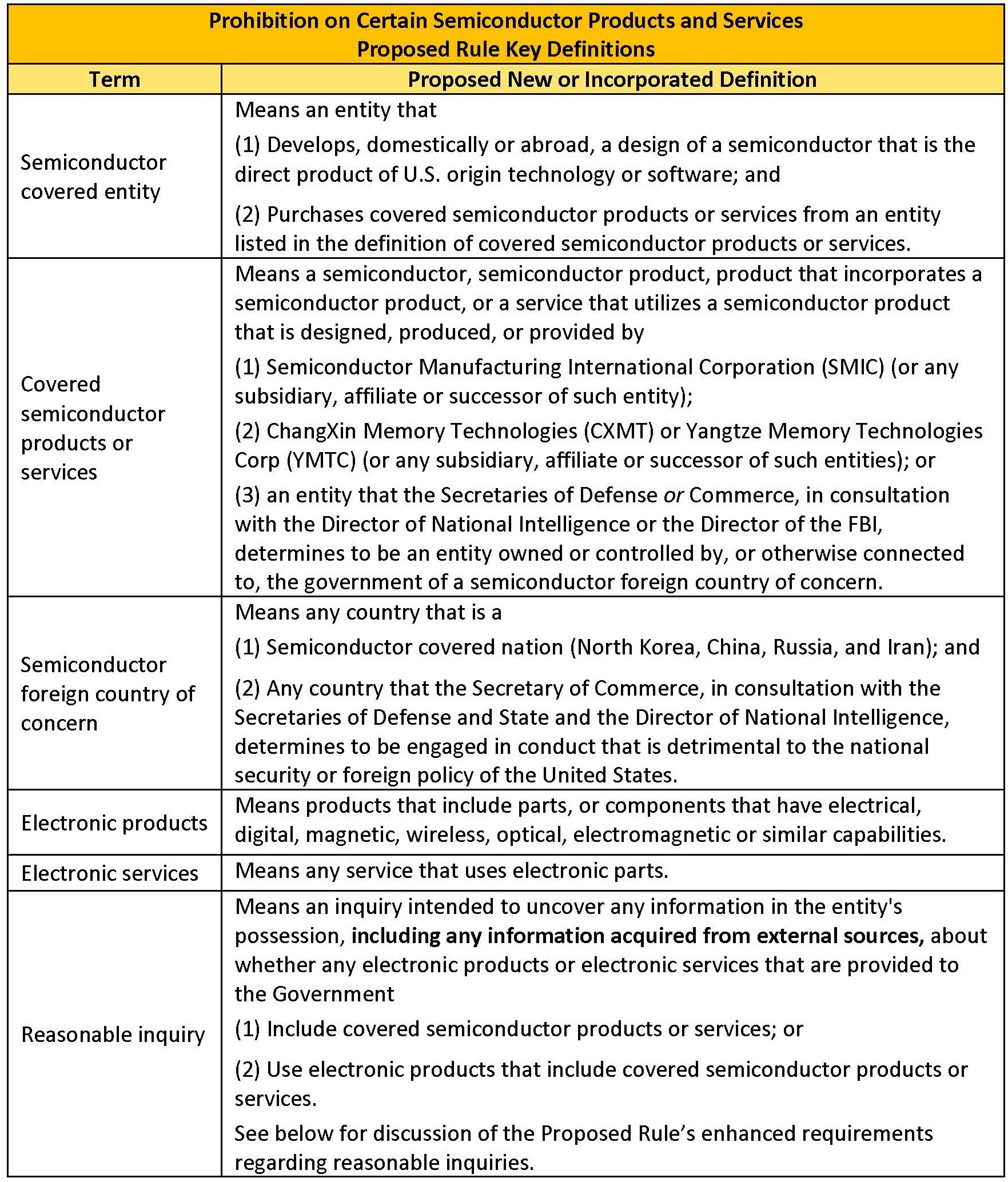
- Section 5949(a)(1)(A) (Part A) prohibits agencies from acquiring electronic products or services that include covered semiconductor products or services. Part A is focused on what is delivered to the agency customer and applies to all procurements.
- Section 5949(a)(1)(B) (Part B) prohibits agencies from acquiring any electronic products or services that use electronic parts or products that include covered semiconductor products or services for use in a “critical system” (even where the agency is not acquiring the semiconductor products or services that are being used). This will likely require contractors to look at how the electronic products or services being acquired by the agency are connecting to, enabling, or leveraging other electronic products.
The Proposed Rule provides clarification regarding scope and incorporated themes raised in the ANPR, such as providing a safe harbor for reporting and remediation. The Proposed Rule applies to an expansive range of government contracts; as the FAR Council explains, semiconductors “power tools as simple as a power adapter and as complex as a fighter jet or a smartphone.”
Overview of Proposed Rule
The Proposed Rule would implement the prohibitions introduced in Section 5949 through the creation of a new solicitation provision, FAR 52.240-XX, Certification Regarding Certain Semiconductor Products and Services, and a corresponding contract clause, FAR 52.240-YY, Prohibition on Certain Semiconductor Products and Services.
Certification Requirement. The solicitation provision will require an offeror to certify, after conducting a reasonable inquiry, that the offeror will not provide (1) any electronic products or services that include covered semiconductor products or services except as disclosed alongside the certification, and (2) for use in critical systems identified by the Government, electronic products that use electronic products that include covered semiconductor products or services except as disclosed alongside the certification.
Reasonable Inquiry. The Proposed Rule defines “reasonable inquiry” expansively, to include information in an offeror’s possession and “any information acquired from external sources” about whether electronic products or services offered to the government include or use covered semiconductor products or services. The commentary to the rulemaking states that the reasonable inquiry standard requires contractors to “assess which electronic products or electronic services are included in its offerings to the Government and seek out information to identify the source of semiconductor products or services.” The Proposed Rule clarifies that, if an offeror is unable to make definitive determinations, the offeror must require its suppliers to conduct reasonable inquiries and certify whether their electronic products and electronic services are compliant.
As in the Section 5949 statue and the ANPR, the reasonable inquiry does not require a formal audit from a third party, and the FAR Council even acknowledged that it opted against requiring artifacts to demonstrate compliance. However, the Proposed Rule still requires an offeror to conduct an enhanced inquiry, beyond certifications provided by its subcontractor or supplier, if the offeror discovers any discrepancies or has reason to doubt the accuracy of the certification. The FAR Council also indicates that it expects offerors to undertake a “full review” of all electronic products and services they may offer to the government, rather than conducting solicitation-specific assessments.
Altogether, the Proposed Rule suggests a higher burden on offerors than comparable regulatory definitions of reasonable inquiry. For example, the required reasonable inquiry under FAR 52.204-24 and -45 does not require contractors to flow down any reasonable inquiry obligation to their subcontractors or suppliers.
Pre-Award Disclosure. If an offeror is aware that its offered electronic products or services contain covered semiconductor products and services, it must disclose this information with its proposal so that the government may decide if an exception or waiver applies.
Prohibitions, Exceptions, and Waivers. The contract clause requires compliance with the relevant prohibitions throughout contract performance. Commercial service procurements, except for procurements of IT and Telecom services, would be excepted from the Section 5949 prohibition. Electronic services incidental to contract performance would also be excepted.
The Proposed Rule contemplates an exception for commercial products or commercial services for which there are no alternative sources available, but states that the government alone may invoke the exception, and the exception will regardless expire on December 23, 2028. Heads of agencies will be able to issue waivers, though the waivers are not meant to provide “an indefinite reprieve” from the prohibitions.
Disclosure. If a contractor identifies, has a reason to suspect, or is notified by a subcontractor that the contractor has included a covered semiconductor product or service in its offering to the government, the contractor must report to the relevant contracting officer(s) within 72 hours, regardless of whether an exception applies. The 72-hour reporting window is a far cry from Section 5949’s statutory 60-day window, but the FAR Council’s commentary emphasizes that the window is similar to required notifications in other similar FAR clauses.
Prospective Application. Consistent with Section 5949, the Proposed Rule also clarifies that it applies prospectively, suggesting that “rip-and-replace” of covered semiconductor products and services is not required, and replacement components, spare parts, and support services required for existing equipment will not be impacted by the prohibitions. The Proposed Rule clarifies that executive agencies will not be required to (1) remove or replace products or services “resident in equipment, systems, or services” before the prohibition’s effective data, or (2) prohibit or limit the use of covered semiconductor products or services through the lifecycle of equipment that was acquired before December 23, 2027. However, contractors would still be required to disclose use of these electronic products and services, and the Government could determine that the exception does not cover the contractor’s specific use.
Safe Harbors. The Proposed Rule creates two “safe harbors” for offerors and contractors that disclose the inclusion of covered semiconductor products or services in their government offerings:
- Pre-Award: If an offeror provides a pre-award disclosure of the inclusion of covered semiconductor products or services in electronic products offered to the government, the offeror will not be subject to civil liability or determined to be not “presently responsible” based on the notification. If the disclosing offeror manufactured or assembled the electronic products in question, that offeror must identify and remove the covered semiconductor products or services to benefit from the safe harbor.
- Post-Award: After award, a contractor may be eligible for the benefits of the pre-award safe harbor if the contractor discloses the inclusion of covered semiconductor products or services in electronic products within the 72-hour window.
Disclosures to non-Government Customers. The Proposed Rule additionally requires that “semiconductor covered entities” disclose the inclusion of a covered semiconductor product or service in electronic products or electronic services to non-government customers. No specific format is required for these disclosures, and the Proposed Rule contemplates that companies may disclose this information in marketing information or on websites. While this requirement arguably will only apply to entities in the government’s supply chain that would be subject to the eventual FAR clause, the disclosure requirement may be aimed at facilitating prime contractor compliance and increasing commercial awareness regarding the vulnerabilities associated with covered semiconductor products and services.
Identifying Covered Semiconductor Products or Services. The Proposed Rule introduces potential online tools to help contractors identify covered semiconductor products and services. The Proposed Rule states that the Department of Commerce (Commerce) will create a website listing entities determined to be owned or controlled by, or otherwise connected to, the government of a semiconductor foreign country of concern, i.e., China, North Korea, Russia, or Iran, or (2) a country that Commerce deems to be “engaged in conduct that is detrimental to the national security or foreign policy of the United States.” It appears that such determinations would first be published in the Federal Register and then added to the eventual website. The FAR Council is also considering a Commerce website listing entities that have certified that their electronic products and services do not contain any prohibited covered semiconductor products or services. The Proposed Rule states that offerors would be able to rely on that website as a reasonable inquiry for the listed products and services, unless they identify discrepancies or have a reason to doubt the accuracy of relevant certifications.
Conclusion
Overall, the Proposed Rule represents a continued emphasis on supply chain security both in terms of reducing or eliminating vulnerabilities that may be embedded in electronic parts and services and moving away from an over-dependence on adversaries for critical materials and components. The Proposed Rule’s discussion of policy states a clear understanding of semiconductor supply chain transparency is critical to U.S. national security objectives, highlighting that these requirements are here to stay.
Contacts




Insights

Client Alert | 6 min read | 10.26.26
Executive Order Creates Women’s Health Task Force, Rescinds Prior Initiatives
On October 19, 2026, President Trump signed an executive order (EO) titled “Advancing Women’s Health to Improve Outcomes in All Phases of Life,” establishing new federal infrastructure dedicated to improving women’s health research, clinical translation, and coordinated policy leadership. The EO creates a White House Women’s Health Task Force and directs the U.S. Department of Health and Human Services (HHS) to establish a new Women’s Health Division within the National Institutes of Health (NIH).
Client Alert | 7 min read | 10.22.26
Africa, MENA, and the Arbitration Act 2025: LCIA’s Latest Report
Client Alert | 4 min read | 10.22.26
CMS Proposal Would Require Extensive Provider Directory Changes in MA
