
FTC Announces Annual Update to HSR and Section 8 Thresholds
Client Alert | 1 min read | 01.20.26
The Federal Trade Commission (FTC) has announced its annual updates to the thresholds and filing fees related to the Hart-Scott-Rodino Antitrust Improvements Act of 1976 (the HSR Act). These dollar thresholds are indexed annually based on changes in the U.S. gross national product and the Consumer Price Index.
The HSR Act requires that certain transactions be notified prior to their consummation. This year, the “size-of-transaction” threshold for reporting mergers and acquisitions under the HSR Act will increase from $126.4 million to $133.9 million. In addition, the “size-of-person” threshold, the filing fee thresholds, and the fee schedule will all also increase. The new filing fee thresholds and fee schedule are as follows:
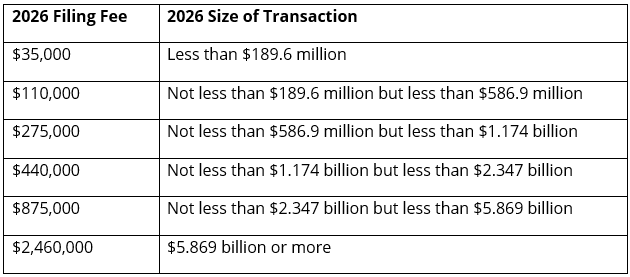
The FTC also issued revised thresholds relating to the prohibition of certain interlocking directorates under Section 8 of the Clayton Act.
The revised thresholds will become effective 30 days after their publication in the Federal Register, which is expected in the next few days. Click here to read a full copy of the FTC's announcement, including a complete listing of the revised thresholds. Click here for a copy of the FTC’s announcement and information regarding the Clayton Act, Section 8 thresholds.
We would like to thank Associate Emil Zhang for their contribution to this alert.
Contacts




Insights

Client Alert | 3 min read | 11.13.26
Massachusetts Trade Secret Preliminary Injunctions: Prove the Harm, Tailor the Relief
A strong trade secret claim is not a substitute for proof of irreparable harm. In Daikin Applied Americas Inc. v. Russo, No. SJC-13881 (Mass. Oct. 14, 2026), the Massachusetts Supreme Judicial Court held that likely success on a misappropriation claim does not create a presumption of irreparable harm. The court grounded its ruling in both the Massachusetts Uniform Trade Secrets Act and the traditional equitable principles the statute incorporates. It required a case-specific showing that the requested relief would prevent harm that a final judgment could not adequately remedy.
Client Alert | 1 min read | 11.12.26
SBA Announces Doubling Veteran Contracting Target to 10% for FY 2027, but Questions Remain
Client Alert | 6 min read | 11.12.26
Client Alert | 2 min read | 11.11.26
President Trump Nominates Peter Feldman to Serve as CPSC Chairman and Commissioner
